

Featured image by Jakub Zerdzicki via Pexels.
With every platform from Facebook to Mailchimp offering ways to collect information on user engagement, it’s easier than ever to collect data on any and every aspect of your business. The hard part is actually using that data. Data is only helpful if you know how to use it, and without a concrete plan for doing so, “data creep”—the gradual buildup (and often repurposing) of data beyond the original reason for its collection—can lead to disorganized file systems, decreased productivity, and gigabytes of outdated data that eventually becomes more of a hindrance than a source of help.
As is often the case for any marketing project, the key to effective data management isn’t improved filing systems or daily check-ins, but planning. Even if you know exactly where you want to go, you need a roadmap to get there, and that’s where key performance indicators (KPIs) come in. Key performance indicators (KPIs) are measurable indicators that show how effectively you and/or your team are achieving company- or department-wide goals. KPIs help you, among other things, collect data with intention, turning overwhelming or ineffective metrics into strategic, effective decisions.
Metrics and KPIs: What’s The Difference?
You may be wondering: isn’t “KPI” just another word for metrics? After all, metrics can be used as indicators of performance. Although KPIs and metrics are quite similar, they aren’t the same thing. So, what’s the difference? Every KPI is a metric, but not every metric is a KPI. Metrics are data points, including anything that is measured as part of routine business operations. Metrics can be used to track performance across multiple areas, even if the metrics weren’t collected with a specific project in mind. Unlike KPIs, metrics don’t usually have a specific end goal attached, whether relevant to a business’ goals or not.
Email delivery rates, for example, may not be a metric or KPI that is relevant to your business’ goals, but measuring and analyzing that metric can help you achieve a relevant KPI. For instance, if one of your project goals is to increase your email conversion rate by 10% over 6 months, a relevant KPI may be “increase email conversion rates by 2% each month.” KPIs serve as indicators of your team’s progress towards a broader goal. Essentially, a KPI is a metric with a defined purpose.
Metrics—email delivery rates, for example- are:
- Data points or collections of data that are collected as part of routine business operations
- Not usually collected with a specific end goal in mind
KPIs (key performance indicators)— “increase email conversion rates by 10% over the next six months,” for example—are metrics collected with a purpose or goal in mind. These usually follow the SMART goal framework:
- Specific
- Measurable
- Achievable
- Relevant
- Time-bound
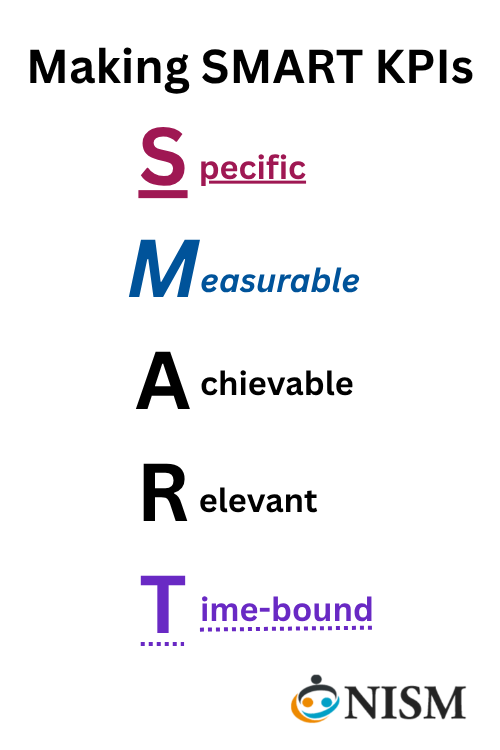
Breakdown of the SMART goal acronym.
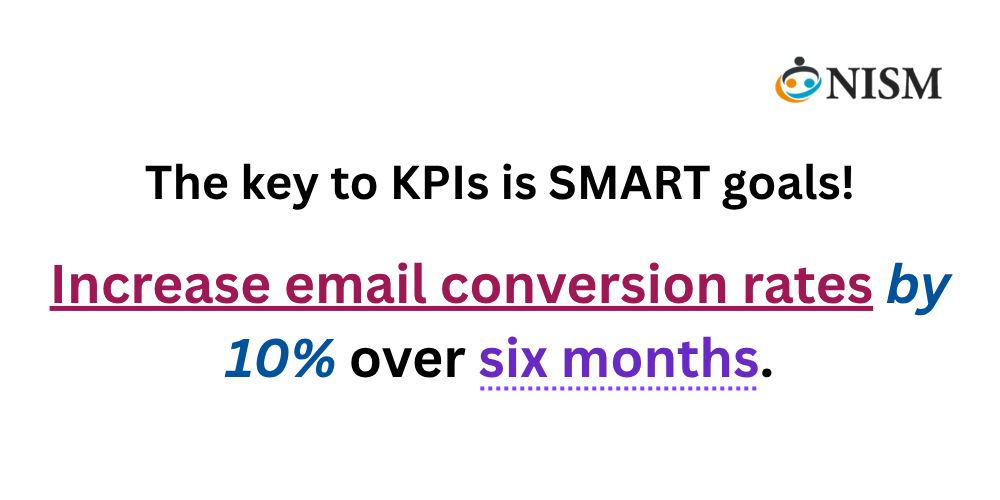
Example of a clear SMART goal.
Why—And How—To Use KPIs
Apart from increasing productivity and ensuring effective, strategic decision-making, KPIs help you to define excellence and—most importantly—achieve it. Without KPIs, it can be easy to give up control over a project or a marketing team’s performance. Work quickly becomes Sisyphean; workdays are nothing but a series of boulders pushed aimlessly up hills. Condemned by the gods of data creep and disorganization, as soon as you complete a project and reach the top of the hill, the boulder rolls back down to the bottom, leaving you and your team right back where you started.
Unlike Sisyphus, however, you can escape your divinely ordained punishment! Better yet, it only takes four easy steps to create a KPI that will keep your team on track, no matter what barriers (or boulders) you may face. Creating a KPI always starts by defining your overall goal and creating SMART goals that will help you achieve it. You may even choose to turn your initial goal into a SMART goal.
SMART Goals & Using KPIs
To understand SMART goals, let’s start with an example of a non-SMART goal without an obvious KPI: to “improve email marketing.”
- Specific: SMART goals need to be specific, so avoid vague language or buzzwords. Improving email marketing may be a worthwhile goal. However, you can improve email marketing in an almost infinite variety of ways, making this goal far too vague to be realistic. Furthermore, a vague goal makes it difficult to identify when the goal has been accomplished, leading to confusion and decreased feelings of achievement when the goal is met. To make it more specific, define what “improving” email marketing means. “Increase email conversions,” for instance, is a far more specific goal.
- Measurable: SMART goals must be measurable. To make “increase email conversion rate” a SMART goal, you not only have to make it more specific, but you must also be specific about how success is measured, typically by assigning a percentage or other amount to your goal. “Increase email conversion rate by 10%” is a measurable goal because it ties success to a specific, measurable metric.
- Achievable – Unfortunately, achieving a 100% conversion rate for marketing emails is nearly impossible. Setting unrealistic goals can lead to burnout, frustration, and a lack of feelings of accomplishment among staff, so make sure that your goals are achievable. “Increase email conversion rate to 100%” is an unrealistic goal, while “increase email conversion rate by 10%” is a challenging, yet achievable goal.
- Relevant – Every goal must be relevant to the task, project, or overall business objective. For a digital marketing team, “increase email conversion rate by 10%” is a relevant goal, but that same goal is far less relevant for, say, an accounting team, unless that accounting team is also responsible for email marketing.
- Time-bound – Deadlines can be stressful, but without setting specific time frames for your goals, it’s easy to spend weeks, months, or even years refining the results, distracting from other projects and decreasing productivity. Achievable and time-bound go hand-in-hand, and an achievable goal can easily be made unachievable by setting an unrealistic deadline. Make sure that your goals are achievable within the time frame you’ve set. “Increase email conversion rate by 10% within two days” turns an otherwise achievable goal into an unachievable one. “Increase email conversion rate by 10% within six months,” however, is a challenging, yet realistic goal.
Once you’ve created a challenging, yet realistic SMART goal, use that SMART goal to create KPIs.
- Create a list of critical success factors (CSFs) your business may need to help you achieve that goal. These could be anything from ensuring that all employees involved with the project can access Mailchimp to updating a mailing list.
- Identify any relevant KPIs that align with your SMART goal(s). As mentioned above, if one of your project’s goals is to increase email conversion rate by 10% within six months, a relevant KPI could be to increase your email conversion rate by 2% every month for six months.
- Set up regular check-ins to review your KPIs, adjust your strategies based on the data you collect, and make sure to celebrate milestones—big or small—along the way!
Whether you’re resolving data creep or simply planning a project, any successful journey needs a goal. KPIs, or key performance indicators, are an effective way to ensure and measure success, turning overwhelming metrics and vague goals into concrete action, increased productivity, and greater satisfaction for teams and companies alike.
 Author Bio:
 Author Bio:
Kathryn “Katie” Bergquist is a recent graduate who currently works for her alma mater, St. Olaf College, as a Communications Coordinator. When she’s not writing or reading, you can find her knitting, crocheting, or hanging out with her cats—there’s always bound to be a little bit of cat fur in every project! This past March, she had the honor of presenting a portion of her recently published work, “‘The Prince’s Jester’ and ‘My Uncle’s Fool’: Foolishness and Metamorphosis in Much Ado About Nothing” at the Sigma Tau Delta (International English Honors Society) Convention in New Orleans, and she hopes to publish additional work—both analytical and otherwise—in the future.
Connect with Kathryn on LinkedIn!
0 Comments